

The Reality of Managing Multiple Club Processes
Running a sports club involves more than training sessions and competitions.
Clubs must handle registrations, athlete evaluations, and payments every season.
Traditionally, these processes are managed using different tools.
Registrations may happen through forms or emails.
Evaluations may live on paper or spreadsheets.
Payments may be handled through separate checkout tools.
This separation creates gaps in data and extra work for admins.
Why Disconnected Systems Create Problems
When registrations, evaluations, and payments live in different places, clubs lose visibility.
Admins must move data manually between systems.
- Athlete records become incomplete
- Evaluation history is disconnected from registrations
- Payment confirmation does not always link back to athlete profiles
Over time, this leads to errors, delays, and confusion.
How Clubs Traditionally Handle Registrations
Many sports clubs still collect registrations manually.
This often includes
- Downloadable forms
- Email confirmations
- Spreadsheet tracking
- Manual data entry
These steps slow down onboarding and increase admin workload, especially during peak registration periods.
Where Evaluations Get Disconnected
Evaluations are often handled separately from registrations.
Even when athlete data exists, evaluations are stored elsewhere.
Coaches may use printed checklists or personal files.
Admins struggle to connect evaluations to athlete records.
This makes long-term tracking difficult and limits reporting.
Payments as a Separate Process
Payments are frequently managed outside core club systems.
Clubs may use standalone payment tools that do not link directly to registrations or evaluations.
As a result, admins must verify payments manually and reconcile records.
This adds friction and increases the chance of mistakes.
Why Clubs Are Moving to One System in 2026
In 2026, clubs are moving away from disconnected tools.
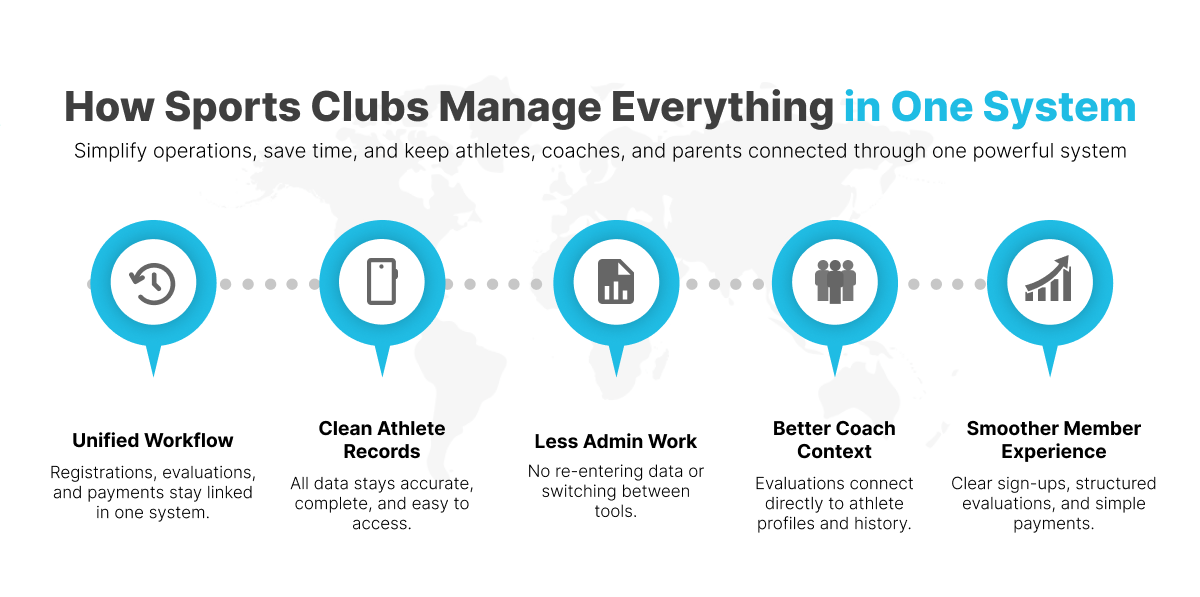
They want one system where registrations create athlete profiles, evaluations attach to those profiles, and payments remain linked to programs and athletes.
This unified approach reduces admin work and improves accuracy.
What Managing Everything in One System Means
Managing registrations, evaluations, and payments in one system does not mean adding complexity.
It means creating a single source of truth.
When systems are connected
- Athlete data stays consistent
- Evaluations are easy to find
- Payments are clearly linked
- Reports are accurate
Admins spend less time reconciling information and more time supporting programs.
Benefits for Club Administrators
For admins, a unified system reduces daily friction.
They no longer need to search across tools, re-enter data, or confirm details manually.
Processes become predictable and repeatable.
This is especially important for clubs with seasonal spikes in activity.
Benefits for Coaches and Evaluators
When registrations and evaluations live in the same system, coaches gain context.
- They can see athlete profiles before evaluations
- They can review past results
- They can follow consistent standards
This supports better assessments without extra admin work.
Benefits for Parents and Athletes
Parents and athletes experience smoother onboarding.
- Registrations are clearer
- Evaluations are structured
- Payments are straightforward
This improves trust and reduces confusion, especially in youth sports programs.
How This Supports Club Growth
As clubs grow, disconnected tools create bottlenecks.
A unified system supports growth by maintaining clean data, supporting multiple programs, and reducing reliance on manual work.
Growth becomes manageable instead of chaotic.
Where Checklick Fits
Checklick is designed to support clubs that want registrations, evaluations, and payments connected.
The platform brings together digital athlete evaluations, progress tracking, registration workflows, and storefront payments within one system.
Checklick focuses on real sports club workflows rather than generic business processes.
Final Thoughts
Managing registrations, evaluations, and payments in separate systems creates unnecessary complexity.
In 2026, sports clubs are choosing unified platforms like Checklick that connect these processes into one workflow.
This shift improves accuracy, reduces admin work, and supports long-term club operations.
That is why managing everything in one system is becoming the standard for modern sports clubs.
