

How Olympic Athletes Are Made: The Role of Structured Skill Tracking
The 2026 Winter Olympics in Milan-Cortina gave the world something it always loves: watching the best athletes in the world make the impossible look effortless. Whether it was a skier carving a near-perfect run down the Tofane Alpine Skiing Centre or a speed skater shattering a personal best, every performance shared one invisible common thread. None of it happened by accident. Every single one of those athletes followed a structured, documented, stage-by-stage development path that started long before they ever saw an Olympic starting gate.
For sports clubs that run youth programs, certification-based progressions, or instructor-led training, that Olympic development model is not out of reach. In fact, it is the exact model that the best-run clubs in the world are already applying. The difference between a club that produces consistently developed athletes and one that does not often comes down to one thing: whether skill development is being tracked systematically or left to memory and guesswork.
The Structure Behind Olympic-Level Athlete Development
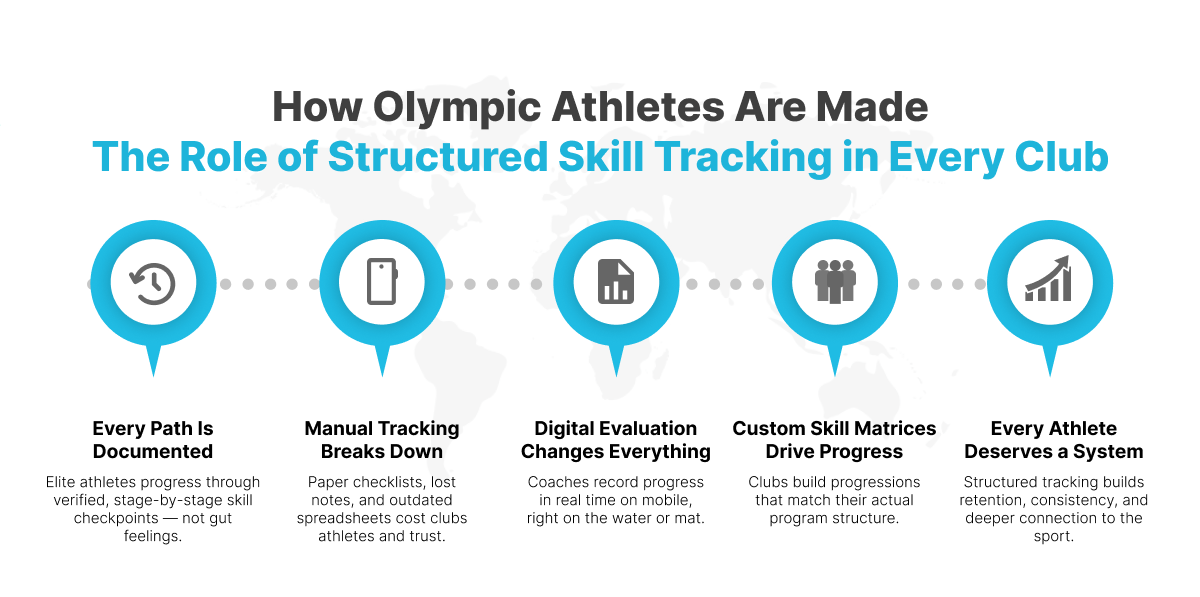
Olympic athletes do not progress based on a coach’s general impression. They progress because they can demonstrably do specific things. A downhill skier completes specific gate training sequences. A judo athlete achieves specific throws with specific technique at a verifiable level of consistency. A speed skater passes defined milestones at defined intervals. The governing bodies of each sport have created structured skill matrices, and athletes move through them one verified checkpoint at a time.
This is not bureaucracy for its own sake. Structured skill tracking serves several critical functions. It gives coaches objective data rather than subjective impressions. It gives athletes clear targets rather than vague encouragement. It gives parents and guardians transparency into how their child is actually progressing. And it gives organizations the ability to see patterns across hundreds of athletes, identifying where development gaps are most common so they can improve their programs.
At the grassroots level, every youth sailing program, every junior judo class, every learn-to-swim course follows a version of this logic. The difference is whether that logic lives on a clipboard, in someone’s head, or in a system that makes it reliable, shareable, and actionable.
 Why Manual Tracking Fails at Scale
Many clubs start out managing athlete evaluations manually. Coaches fill out paper checklists. Instructors keep notes on individual students. Program coordinators compile spreadsheets at the end of each season. This works when programs are small, but it creates predictable failure points as clubs grow.
Paper checklists get lost. Spreadsheets go out of date. When an instructor leaves mid-season, their notes leave with them. When a family calls to ask about their child’s progress, no one can give them a real-time answer without pulling out a binder. When a student returns for a second season, there is no reliable record of exactly where they left off. The club ends up re-evaluating from scratch or, worse, simply guessing.
The result is that athletes do not progress as efficiently as they should. Coaches spend more time on administration than instruction. Families lose confidence in the program. And the club loses the kind of retention that drives long-term growth.
What Structured Digital Tracking Actually Looks Like
Clubs that have moved to a structured digital evaluation system describe a fundamentally different experience. Coaches evaluate athletes directly from a mobile device, right there on the water or on the mat. Progress is recorded in real time. Certificates are generated digitally. Parents can see exactly where their child stands in the program pathway without needing to contact anyone.
This is not hypothetical. Clubs using Checklick’s Athlete Development Tracking System report that instructors can access up-to-date class rosters and record student progress directly without manual updates. At Starlight Sailing Adventures, the move to digital evaluations and certifications gave the school a more polished and professional image while also giving the team a scalable system for future growth. These are not marketing claims. They are documented outcomes from clubs that made the switch.
The key capability that makes this work is a customizable skill matrix. Rather than using a one-size-fits-all checklist, clubs can build skill progressions that reflect their actual program structure, whether that follows CANSail levels, a national judo curriculum, or a custom internal framework. Coaches evaluate against those specific criteria. Athletes get meaningful feedback tied to their actual program goals, not generic assessments.
The Link Between Grassroots Tracking and Elite Development
It would be easy to dismiss the comparison to Olympic athletes as aspirational. But consider what happens when every athlete in a club program receives structured, documented, stage-by-stage development from their very first class. They progress more consistently. They stay in the program longer. They develop the kind of foundational competency that makes the next level accessible. Some of them go on to compete. Some of them go on to coach. All of them carry a deeper relationship with their sport.
The clubs that produce the most engaged, the most technically sound, and the most loyal participants are the clubs that treat every athlete’s development as worth documenting. Not because every participant will make it to the Olympics, but because every participant deserves a development experience that is intentional, visible, and consistent. That starts with how a club tracks skill.
Checklick: Built for the Way Clubs Actually Work
Checklick’s Athlete Development Tracking System is designed specifically for sports clubs. It is not a generic HR tool or a repackaged school grade tracker. It allows clubs to build customized skill matrices tailored to their program, track athlete progress using mobile devices on the field or on the water, send progress updates and digital certificates directly to participants, and manage instructor access so coaches always have the current information they need.
Hundreds of sports clubs trust Checklick to simplify evaluations, sell programs online, and manage athlete development. The system is used across sailing organizations, judo and wrestling clubs, and a range of other certification-driven sports. The platform operates with a 30-day free trial so clubs can experience the full system before committing, with a monthly evaluator plan starting at $15 per month for clubs with fewer than 50 evaluators.
The Olympic athletes we watched compete in Milan-Cortina did not get there because their coaches had good intentions. They got there because someone built a system around their development and followed it every single day. Every sports club has the ability to build that same system for every athlete it serves. The technology exists. The only question is whether a club is ready to use it.
Start your 30-day free trial at checklick.com and see how structured athlete development tracking transforms your club.
