

Table of Contents
ToggleWhy Standardization Matters at the National Level
National Sports Organizations oversee multiple clubs, programs, and regions.
One of their core responsibilities is maintaining consistent standards for athlete development across all affiliated clubs.
Without standardization, evaluations vary widely.
Athletes are assessed using different criteria, coaches interpret skills differently, and development pathways become unclear.
Over time, this inconsistency affects data quality, fairness, and national oversight.
In 2026, NSOs are placing greater importance on standardized evaluation systems to ensure alignment across clubs.
The Challenge of Managing Evaluations Across Multiple Clubs
When clubs operate independently, evaluation methods naturally diverge.
Each club may use its own forms, scoring systems, or evaluation schedules.
For NSOs, this creates several challenges.
Comparing athlete progress across clubs becomes difficult.
Reporting lacks consistency.
Identifying development trends at a national level requires manual effort and interpretation.
Manual coordination across clubs does not scale as programs expand.

Why Manual Standardization Does Not Work Long Term
Some NSOs attempt to standardize evaluations using shared documents or guidelines.
While this creates a reference point, it does not ensure consistent execution.
Clubs may interpret criteria differently.
Forms may be modified.
Records may not be submitted uniformly.
Over time, deviations increase and oversight weakens.
Standardization requires more than guidelines.
It requires a system that enforces structure.
How Centralized Evaluation Systems Support Standardization
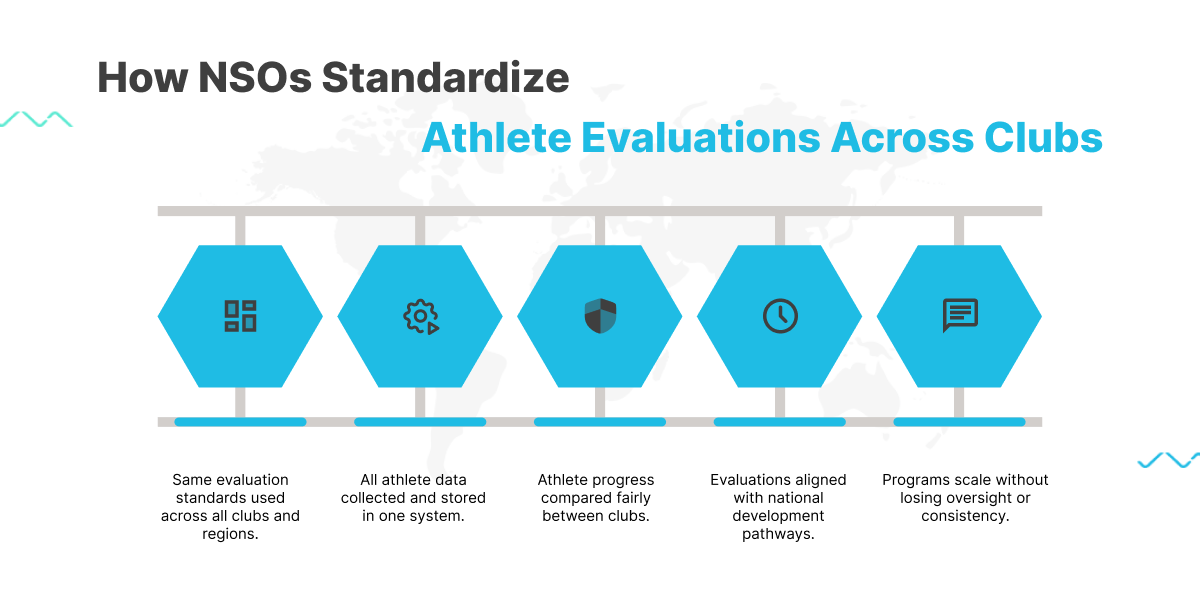
Centralized athlete evaluation systems allow NSOs to define evaluation criteria once and apply them across all clubs.
When clubs use the same digital checklists, standards remain consistent.
Evaluations follow the same structure regardless of location or evaluator.
Data is collected in a uniform format, making comparison and reporting easier.
This approach supports true standardization rather than loose alignment.
Maintaining Consistent Development Pathways
NSOs often define development pathways that outline how athletes progress through levels or stages.
Evaluations play a key role in measuring this progress.
Standardized evaluation systems ensure that assessments align with these pathways.
Athletes are evaluated against the same benchmarks.
This supports fair progression decisions and long-term planning.
Consistency strengthens the integrity of national development programs.
Improving Visibility Across Clubs and Regions
Standardized digital evaluations provide NSOs with clearer visibility across their network.
Instead of collecting reports manually, organizations can review evaluation data centrally.
Patterns and trends become easier to identify.
Oversight improves without increasing administrative burden.
This visibility supports data-informed decisions at the organizational level.
Where Checklick Fits
Checklick supports National Sports Organizations by enabling standardized athlete evaluations across multiple clubs.
The platform allows organizations to create structured evaluation checklists, share them across clubs, and collect consistent evaluation data.
Checklick supports centralized oversight while allowing clubs to operate within a shared framework.
Final Thoughts
Standardizing athlete evaluations across clubs is essential for National Sports Organizations.
It ensures fairness, consistency, and clarity across programs and regions.
In 2026, NSOs rely on centralized evaluation systems to move beyond manual coordination and create aligned development frameworks.
This shift supports stronger oversight and more effective athlete development nationwide.