Why Manual Club Management Feels Cheaper Than It Is
Many sports clubs continue to operate without dedicated software because manual tools appear inexpensive. Paper forms, spreadsheets, and emails feel familiar and easy to maintain. There is no obvious subscription cost, and processes seem manageable at first. However, the real cost of manual club management does not show up on a balance sheet. It appears gradually through lost time, repeated work, data gaps, and operational stress. In 2026, these hidden costs are becoming harder for clubs to ignore.Time Is the First Cost Clubs Overlook
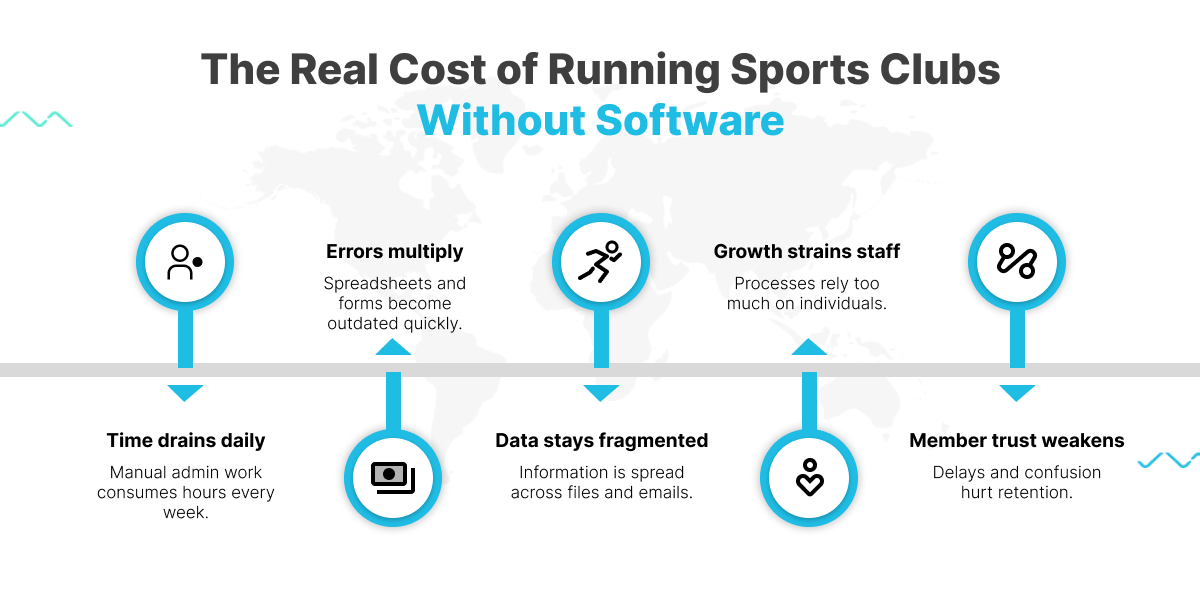
Managing a sports club without software requires constant manual effort. Registrations must be collected and entered. Athlete information must be updated across files. Evaluations must be stored and retrieved manually. Payments must be tracked and confirmed separately. Each task takes time on its own. Together, they create a daily workload that grows every season. Admins and volunteers spend hours maintaining systems instead of supporting athletes and programs. Over time, this time cost becomes significant.Errors Increase as Complexity Grows
Manual systems rely heavily on accuracy and repetition. As clubs grow, this becomes difficult to maintain. Spreadsheets may contain outdated information. Forms may be incomplete. Evaluation records may not match athlete profiles. Payment confirmations may not align with registrations. These errors are rarely intentional, but they are unavoidable when processes depend on manual handling. Fixing them requires additional time and effort, increasing the operational cost of running the club.Data Becomes Fragmented and Hard to Use
Without software, club data lives in many places. Registration information may be stored separately from evaluations. Payment records may sit in another system. Reports must be assembled manually. Fragmented data limits visibility. Clubs struggle to answer simple questions about athlete progress, program performance, or operational workload. As a result, decisions are often made with incomplete information. This lack of clarity becomes a hidden cost as clubs attempt to grow or improve.Growth Creates Pressure on People, Not Systems
Manual club management depends on people remembering processes, maintaining files, and coordinating information. When clubs are small, this dependency is manageable. As clubs grow, reliance on individuals becomes risky. Staff changes, volunteer turnover, or seasonal workload spikes expose gaps quickly. Processes slow down or break entirely because they are not supported by systems. The cost appears as stress, burnout, and operational instability.Parent and Member Experience Suffers Quietly
Parents and members may not see internal workflows, but they feel the effects. Registration delays, unclear communication, missing records, or payment confusion reduce confidence in the club. These issues rarely show up as immediate complaints. Instead, they affect retention, trust, and long-term engagement. Clubs may lose members without understanding the operational causes behind it. This is one of the most overlooked costs of managing without software.Evaluations and Progress Tracking Are Hard to Sustain
Tracking athlete development without software becomes harder over time. Evaluation records are difficult to compare across seasons. Standards change as coaches rotate. Progress resets instead of building forward. Clubs that focus on development struggle to maintain consistency without structured systems. The cost here is not financial. It is the loss of insight into athlete growth and program effectiveness.Reporting Becomes a Manual Burden
Many clubs need reports for internal review, parents, or governing bodies. Without software, reporting requires manual compilation. This process is slow and prone to errors. Data must be gathered from multiple sources and aligned manually. As reporting needs increase, the effort required grows disproportionately. This limits how often clubs can review performance and make informed improvements.The Cost of Delayed Decisions
When data is scattered and processes are manual, decisions take longer. Clubs hesitate because information is incomplete or outdated. Delayed decisions affect scheduling, program planning, staffing, and development pathways. Over time, this slows growth and reduces competitiveness. The cost here is opportunity lost, not money spent.