

While hourly pay and wages are often the first thing coaches look at when considering a position, compensation does not stop with salary alone. Many organizations provide additional non-monetary benefits that help coaches grow professionally, stay connected to the sport, and feel valued by their clubs.
The 2025 Checklick Coach Compensation Survey, with 234 responses, included a question focused specifically on non-monetary compensation. The goal was simple: understand what additional benefits organizations offer beyond wages.
These benefits can include access to facilities, training support, apparel, food, equipment access, and social activities. While they may not appear on a paycheck, these perks can play an important role in coach satisfaction, retention, and development.
What We Asked
Coaches were asked:
“What additional benefits (non-monetary) does your employer offer?”
Respondents could select multiple options from a list of 14 potential benefits, including training support, equipment access, and club privileges. Participants could also select “None of the above / Not applicable” if they received no additional benefits.
The survey included the following benefits:
- Opportunities for competition
- Free use of club facilities/equipment
- Honourary club membership
- Full or partially paid prerequisite courses (for example first aid)
- Staff party or social events
- Resources provided upon request (office supplies, manuals, etc.)
- Full or partially paid professional development courses
- Free or discounted food during working hours
- Free apparel
- Equipment use for competition
- Discounts on equipment
- End of season bonus
- Free equipment storage at place of employment
- None of the above / Not applicable
The Most Common Non-Monetary Benefits in 2025
The data shows that some benefits appear far more frequently than others.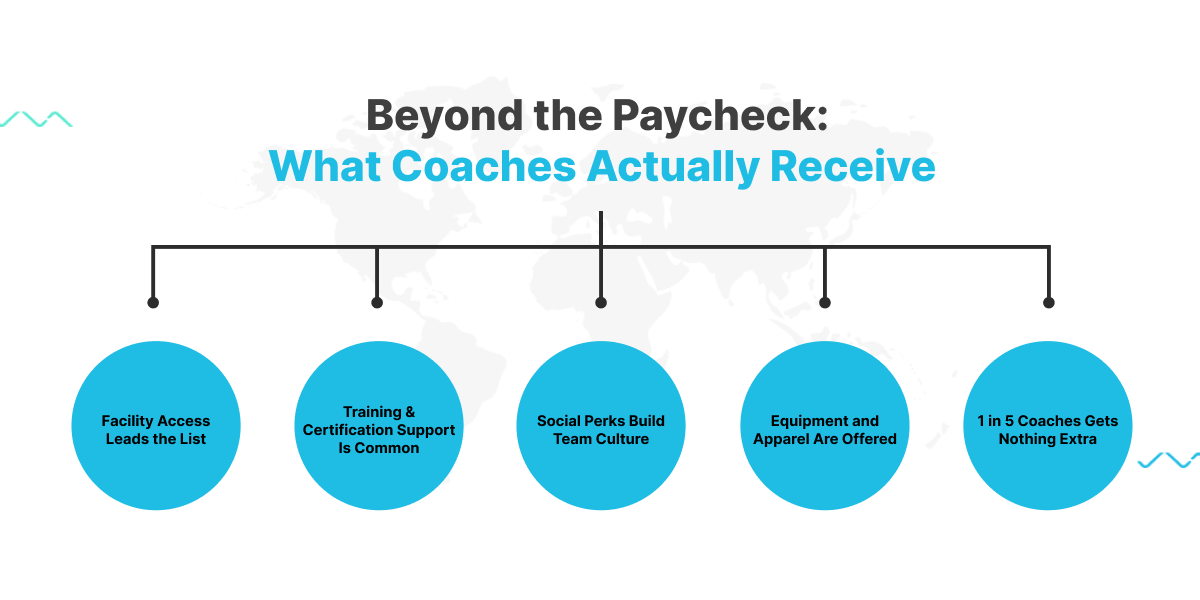
Top Benefits Reported by Coaches

Facility Access Continues to Be the Most Common Perk
Nearly half of all respondents (48.72%) reported receiving free use of club facilities or equipment.
This benefit consistently ranks as the most common non-monetary perk because it provides value without significant additional cost to organizations.
Facility access allows coaches to:
- Continue practicing the sport themselves
- Maintain and improve technical skills
- Stay connected with the athlete community
- Remain actively engaged with club programming
For many clubs, this benefit requires minimal financial investment while still providing meaningful value to coaches.
Professional Development Support Is Widely Offered
Another clear trend in the data is the importance of training and certification support.
In the 2025 survey:
- 37.18% of coaches reported receiving paid professional development courses
- 36.32% reported receiving paid prerequisite courses, such as first aid
These courses are often required for coaching certification or insurance coverage. Supporting coaches through these requirements helps remove barriers to entry and can encourage long-term participation in coaching.
Organizations that invest in coach education may benefit from:
- Improved coaching quality
- Stronger program development
- Increased coach retention
Social and Community Benefits Matter
Non-monetary compensation is not only about equipment and training. Social and community benefits also appear frequently.
In the 2025 survey:
- 38.89% of coaches reported a staff party or social event
- 29.49% reported receiving free or discounted food during working hours
While these benefits may seem small compared to training or equipment access, they can contribute to a stronger team environment and improved workplace satisfaction.
Equipment and Apparel Benefits
Several benefits focus on providing coaches with equipment or apparel.
The survey found that:
- 25.21% receive free apparel
- 19.23% receive equipment use for competition
- 11.11% receive equipment discounts
These benefits help coaches remain active participants in the sport while reducing personal expenses associated with equipment.
Storage and Resources Support
Some organizations also provide practical benefits that help coaches manage equipment and materials.
The survey results show:
- 28.63% receive free equipment storage at their place of employment
- 30.77% receive resources upon request, such as manuals or office supplies
These benefits may seem operational in nature, but they can significantly improve day-to-day coaching logistics.
Not All Coaches Receive Additional Benefits
Despite the variety of perks offered, the survey also shows that some coaches receive none.
17.95% of respondents reported receiving no additional non-monetary benefits.
This highlights a gap between organizations that provide broader support and those that rely solely on hourly wages.
Key Insights From the 2025 Non-Monetary Compensation Survey
Several clear patterns emerge from the data.
- Facility access remains the most common benefit.
- Nearly half of coaches receive access to club facilities and equipment.
- Training support is widely provided.
- Professional development and prerequisite courses are among the most common benefits.
- Social and operational perks are also common.
- Staff events, food, and resources play a meaningful role in overall compensation.
- A portion of coaches still receive no additional benefits.
- Almost one in five respondents reported receiving none of the listed perks.
The Bigger Picture
While wages remain an important part of coach compensation, the 2025 survey demonstrates that non-monetary benefits are a significant part of the coaching experience.
Facility access, training support, equipment use, and social benefits can all contribute to a more attractive coaching environment.
For organizations looking to attract and retain qualified coaches, the survey results suggest that even small perks can make a meaningful difference.
Providing a thoughtful mix of benefits may help organizations build stronger coaching programs while supporting the development and well-being of their staff.
If you want to take a closer look at the survey results and explore the data in more detail. Part 1 focuses on the roles, activity levels, locations, ages, and experience of today’s coaches, while Part 2 examines pay, certifications, and benefits reported across sailing programs.
For a deeper dive into the findings, be sure to explore our follow-up posts:
Coach Compensation Survey – Insights Part 1
Coach Compensation Survey – Insights Part 2
You can also Download the 2025 Coach Compensation Survey – Full Report to explore the complete data and insights.
